


Page 43 - eBook_Proceedings of the International Conference on Digital Manufacturing V1
P. 43
Mechanical Performance and Structural Feasibility of Recycled HDPE in
                      Furniture Design: Experimental and Finite Element Analysis

               Load Application and Boundary Condition

               The  finite element simulation  applied a uniformly  distributed
               vertical  load equivalent to a human body mass of 68.4 kg
               (approximately 671.004 N) across a defined seat surface area of
               1512 mm², resulting in a consistent pressure of 0.4438 N/mm².
               This loading condition closely mimicked real-world ergonomic
               seating scenarios. Fixed  constraints were  applied  to the base
               supports, replicating stable contact conditions with a rigid floor.

               Computational Result and Interpretation

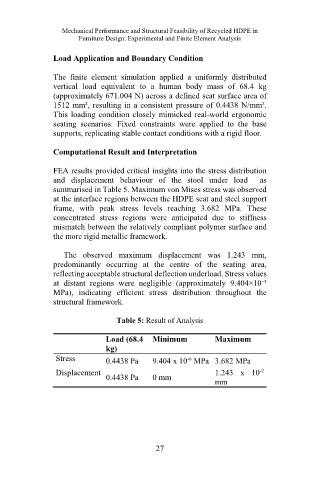
               FEA results provided critical insights into the stress distribution
               and displacement  behaviour  of  the stool under load    as
               summarised in Table 5. Maximum von Mises stress was observed
               at the interface regions between the HDPE seat and steel support
               frame, with peak stress  levels  reaching 3.682 MPa. These
               concentrated  stress regions were anticipated due to stiffness
               mismatch between the relatively compliant polymer surface and
               the more rigid metallic framework.

                  The  observed  maximum  displacement  was  1.243  mm,
               predominantly occurring at the  centre  of  the seating area,
               reflecting acceptable structural deflection underload. Stress values
               at  distant  regions  were  negligible  (approximately  9.404×10⁻³
               MPa),  indicating efficient stress distribution  throughout the
               structural framework.

                                Table 5: Result of Analysis

                              Load (68.4  Minimum          Maximum
                              kg)
                Stress        0.4438 Pa   9.404 x 10  MPa  3.682 MPa
                                                    -6
                Displacement                               1.243 x 10
                                                                       -2
                              0.4438 Pa   0 mm
                                                           mm


                                              27

