


Page 130 - eBook_Proceedings of the International Conference on Digital Manufacturing V2
P. 130
Proceedings of the International Conference on Digital Manufacturing –
                                         Volume 2

               panel as  compared  to fixed panels.  This  is  shown  with the
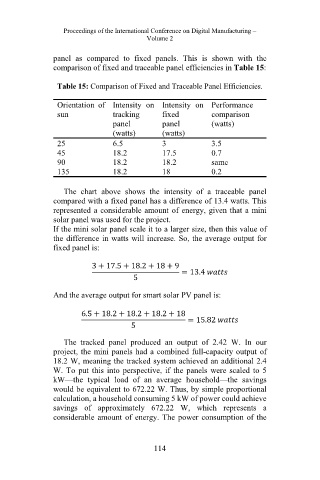
               comparison of fixed and traceable panel efficiencies in Table 15:

                Table 15: Comparison of Fixed and Traceable Panel Efficiencies.

                Orientation of  Intensity on  Intensity on  Performance
                sun             tracking     fixed        comparison
                                panel        panel        (watts)
                                (watts)      (watts)
                25              6.5          3            3.5
                45              18.2         17.5         0.7
                90              18.2         18.2         same
                135             18.2         18           0.2

                  The chart  above  shows  the intensity of a traceable panel
               compared with a fixed panel has a difference of 13.4 watts. This
               represented a considerable amount of energy, given that a mini
               solar panel was used for the project.
               If the mini solar panel scale it to a larger size, then this value of
               the difference in watts will increase. So, the average output for
               fixed panel is:

                          3 + 17.5 + 18.2 + 18 + 9
                                                  = 13.4
                                     5

               And the average output for smart solar PV panel is:


                       6.5 + 18.2 + 18.2 + 18.2 + 18
                                                    = 15.82
                                    5

                  The  tracked panel produced an output  of 2.42 W. In our
               project, the mini panels had a combined full-capacity output of
               18.2 W, meaning the tracked system achieved an additional 2.4
               W. To put this into perspective, if the panels were scaled to 5
               kW—the  typical load of  an average household—the savings
               would be equivalent to 672.22 W. Thus, by simple proportional
               calculation, a household consuming 5 kW of power could achieve
               savings of approximately 672.22  W, which represents a
               considerable amount of energy. The power consumption of the


                                              114

