


Page 61 - eBook_Proceedings of the International Conference on Digital Manufacturing V2
P. 61
Fabrication and Characterization of a Low-Cost Piezoelectric using Rochelle
                         Salt for Energy Harvesting and Sensor Applications


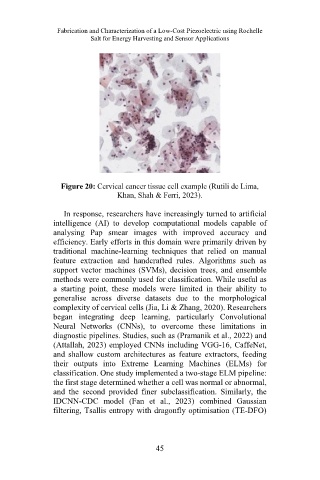
                 Figure 20: Cervical cancer tissue cell example (Rutili de Lima,
                                 Khan, Shah & Ferri, 2023).

                  In response, researchers have increasingly turned to artificial
               intelligence  (AI) to develop  computational models  capable of
               analysing Pap smear images with improved accuracy and
               efficiency. Early efforts in this domain were primarily driven by
               traditional machine-learning techniques  that relied on manual
               feature  extraction  and  handcrafted  rules.  Algorithms such as
               support vector machines (SVMs), decision trees, and ensemble
               methods were commonly used for classification. While useful as
               a starting point, these models were limited  in  their ability to
               generalise across diverse datasets due to the morphological
               complexity of cervical cells (Jia, Li & Zhang, 2020). Researchers
               began integrating deep learning, particularly Convolutional
               Neural Networks (CNNs), to  overcome these  limitations  in
               diagnostic pipelines. Studies, such as (Pramanik et al., 2022) and
               (Attallah, 2023) employed CNNs including VGG-16, CaffeNet,
               and shallow custom architectures as feature extractors, feeding
               their  outputs into Extreme Learning Machines (ELMs) for
               classification. One study implemented a two-stage ELM pipeline:
               the first stage determined whether a cell was normal or abnormal,
               and the  second provided  finer subclassification.  Similarly,  the
               IDCNN-CDC model  (Fan et  al., 2023)  combined Gaussian
               filtering, Tsallis entropy with dragonfly optimisation (TE-DFO)


                                              45

