


Page 64 - eBook_Proceedings of the International Conference on Digital Manufacturing V2
P. 64
Proceedings of the International Conference on Digital Manufacturing –
                                         Volume 2

                  These developments underscore a paradigm shift from hand-
               engineered and CNN-based systems toward Transformer-driven
               architectures, which offer superior scalability and representational
               power (Riana et al., 2023; Hussain, Mahanta, Das & Talukdar,
               2020). Building upon this trajectory, the Swin  Transformer
               emerges as a promising candidate. Its hierarchical window-based
               attention mechanism enables fine-grained local feature learning
               and efficient global context  modelling. While the Swin
               Transformer has achieved competitive results in general-purpose
               vision tasks (e.g., ADE20K, COCO), its potential in cervical
               cytology analysis remains largely unexplored, forming this study's
               foundation.


               MATERIAL & METHODOLOGY

               Dataset Description

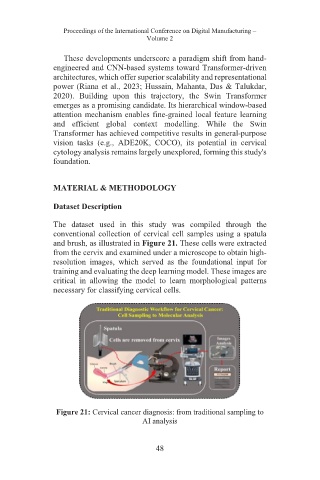
               The dataset used  in this study was compiled through the
               conventional collection of cervical cell samples using a spatula
               and brush, as illustrated in Figure 21. These cells were extracted
               from the cervix and examined under a microscope to obtain high-
               resolution images, which  served as  the foundational input  for
               training and evaluating the deep learning model. These images are
               critical in  allowing  the  model  to learn  morphological  patterns
               necessary for classifying cervical cells.


                Figure 21: Cervical cancer diagnosis: from traditional sampling to
                                       AI analysis


                                              48

