


Page 46 - eBook_Proceedings of the International Conference on Digital Manufacturing V2
P. 46
Proceedings of the International Conference on Digital Manufacturing –
                                         Volume 2

               METHODOLOGY

               Beam Design and Lattice Generation
               A beam  with 70% porous core is designed. The PLA infill
               structures were generated using N-Topology software. The shell
               thickness of the beam was taken as 2.5% of the smallest side of
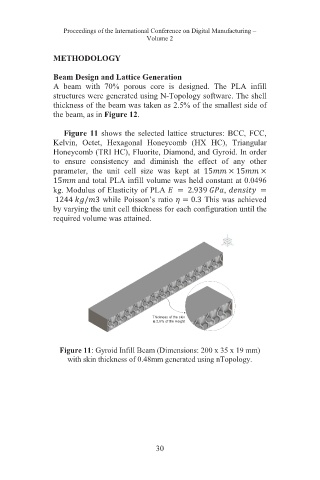
               the beam, as in Figure 12.

                  Figure 11 shows the selected lattice structures: BCC, FCC,
               Kelvin, Octet, Hexagonal Honeycomb (HX HC), Triangular
               Honeycomb (TRI HC), Fluorite, Diamond, and Gyroid. In order
               to ensure  consistency and diminish  the effect  of any other
               parameter, the unit cell size was kept at  15         × 15         ×
               15         and total PLA infill volume was held constant at 0.0496
               kg. Modulus of Elasticity of PLA       =  2.939             ,                               =
                1244         /    3 while Poisson’s ratio      = 0.3 This was achieved
               by varying the unit cell thickness for each configuration until the
               required volume was attained.


                                          Thickness of the skin
                                          is 2.5% of the Height


                 Figure 11: Gyroid Infill Beam (Dimensions: 200 x 35 x 19 mm)
                   with skin thickness of 0.48mm generated using nTopology.


                                              30

