


Page 51 - eBook_Proceedings of the International Conference on Digital Manufacturing V2
P. 51
Enhanced Bending Strength of PLA Beams with Varied Lattice Infill Structures


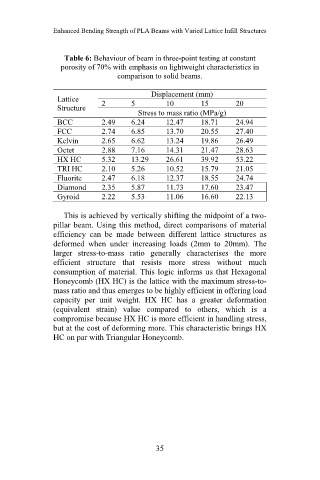
                  Table 6: Behaviour of beam in three-point testing at constant
                 porosity of 70% with emphasis on lightweight characteristics in
                                 comparison to solid beams.

                                          Displacement (mm)
                Lattice     2       5         10       15        20
                Structure
                                      Stress to mass ratio (MPa/g)
                BCC         2.49    6.24      12.47    18.71     24.94
                FCC         2.74    6.85      13.70    20.55     27.40
                Kelvin      2.65    6.62      13.24    19.86     26.49
                Octet       2.88    7.16      14.31    21.47     28.63
                HX HC       5.32    13.29     26.61    39.92     53.22
                TRI HC      2.10    5.26      10.52    15.79     21.05
                Fluorite    2.47    6.18      12.37    18.55     24.74
                Diamond     2.35    5.87      11.73    17.60     23.47
                Gyroid      2.22    5.53      11.06    16.60     22.13

                  This is achieved by vertically shifting the midpoint of a two-
               pillar beam. Using this method, direct comparisons of material
               efficiency can  be made between  different lattice structures  as
               deformed when under increasing loads  (2mm to 20mm). The
               larger stress-to-mass ratio generally characterises the more
               efficient structure  that resists more stress without  much
               consumption of material. This logic informs us that Hexagonal
               Honeycomb (HX HC) is the lattice with the maximum stress-to-
               mass ratio and thus emerges to be highly efficient in offering load
               capacity per unit weight.  HX HC  has a greater deformation
               (equivalent strain) value compared  to others, which  is a
               compromise because HX HC is more efficient in handling stress,
               but at the cost of deforming more. This characteristic brings HX
               HC on par with Triangular Honeycomb.


                                              35

