


Page 67 - eBook_Proceedings of the International Conference on Digital Manufacturing V2
P. 67
Fabrication and Characterization of a Low-Cost Piezoelectric using Rochelle
                         Salt for Energy Harvesting and Sensor Applications

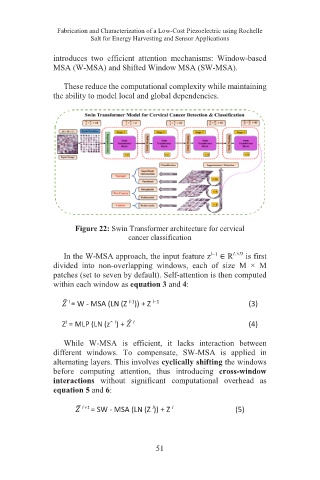
               introduces two  efficient attention mechanisms: Window-based
               MSA (W-MSA) and Shifted Window MSA (SW-MSA).

                  These reduce the computational complexity while maintaining
               the ability to model local and global dependencies.


                     Figure 22: Swin Transformer architecture for cervical
                                    cancer classification

                  In the W-MSA approach, the input feature z  ∈ R L×D  is first
                                                          l−1
               divided into  non-overlapping windows,  each of  size M  × M
               patches (set to seven by default). Self-attention is then computed
               within each window as equation 3 and 4:

                  � l
                                          l−1
                                    l-1
                        = W - MSA (LN (Z  )) + Z                    (3)

                                   � l
                                l
                   l
                  Z = MLP (LN (zˆ ) +                               (4)

                  While W-MSA  is  efficient, it lacks interaction  between
               different  windows. To  compensate,  SW-MSA  is applied in
               alternating layers. This involves cyclically shifting the windows
               before computing attention, thus introducing  cross-window
               interactions  without significant computational overhead as
               equation 5 and 6:

                      � l +1              l    l
                            = SW - MSA (LN (Z )) + Z             (5)


                                              51

