


Page 25 - eBook_Proceedings of the International Conference on Digital Manufacturing V1
P. 25
Degradation Analysis of 3D Printed PLA in Simulated Body


               behaviour, leading to the  observed  acceleration phases during
               specific intervals.

                     0.5                                0.3617     0.3903
                    Weight Different Percentage (%)  0.3  Day 0  Day 7 0.1473 Day 14  Day 21 0.3113 Day 28
                     0.4
                                                                   0.3610
                                                                   0.2944
                                               0.2458
                                                        0.2434
                                      0.2366
                                               0.2338
                                      0.1821
                     0.2
                                                0.1825
                     0.1
                             0 0 0
                       0

                                  Cube     Time Interval  Bar
                                            Dogbone

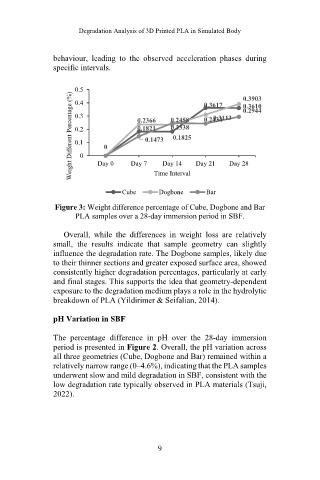
                Figure 3: Weight difference percentage of Cube, Dogbone and Bar
                     PLA samples over a 28-day immersion period in SBF.

                  Overall, while the differences in weight loss are  relatively
               small, the results  indicate that sample geometry can slightly
               influence the degradation rate. The Dogbone samples, likely due
               to their thinner sections and greater exposed surface area, showed
               consistently higher degradation percentages, particularly at early
               and final stages. This supports the idea that geometry-dependent
               exposure to the degradation medium plays a role in the hydrolytic
               breakdown of PLA (Yildirimer & Seifalian, 2014).

               pH Variation in SBF

               The  percentage difference in pH over the 28-day immersion
               period is presented in Figure 2. Overall, the pH variation across
               all three geometries (Cube, Dogbone and Bar) remained within a
               relatively narrow range (0–4.6%), indicating that the PLA samples
               underwent slow and mild degradation in SBF, consistent with the
               low degradation rate typically observed in PLA materials (Tsuji,
               2022).


                                              9

