


Page 23 - eBook_Proceedings of the International Conference on Digital Manufacturing V1
P. 23
Degradation Analysis of 3D Printed PLA in Simulated Body


               using standard buffer  solutions  (pH 4.00,  7.00 and 10.00)  to
               ensure measurement accuracy.

                  At each time point, the entire container—including both the
               PLA sample and the corresponding volume of SBF—was used as
               a single-use unit.

                  The  pH was measured directly in the container  without
               transferring the solution to another vessel. After the pH
               measurement and subsequent sample collection for mass loss
               analysis, both the sample and the SBF were discarded. This single-
               use approach eliminated the risk of cross-contamination between
               time points and ensured consistent experimental conditions.

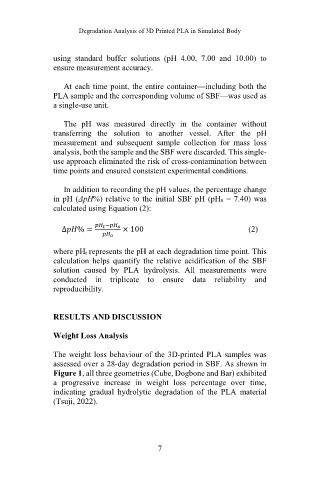
                  In addition to recording the pH values, the percentage change
               in pH (ΔpH%) relative to the initial SBF pH (pH0 = 7.40) was
               calculated using Equation (2):

                                         −                          (2)
                  ∆        %=     × 100


               where pHt represents the pH at each degradation time point. This
               calculation helps quantify the  relative acidification of the SBF
               solution caused  by PLA  hydrolysis. All measurements were
               conducted  in  triplicate  to  ensure  data  reliability and
               reproducibility.


               RESULTS AND DISCUSSION

               Weight Loss Analysis

               The weight loss behaviour of the 3D-printed PLA samples was
               assessed over a 28-day degradation period in SBF. As shown in
               Figure 1, all three geometries (Cube, Dogbone and Bar) exhibited
               a progressive increase  in weight loss percentage  over time,
               indicating gradual  hydrolytic degradation of  the PLA  material
               (Tsuji, 2022).


                                              7

