


Page 22 - eBook_Proceedings of the International Conference on Digital Manufacturing V1
P. 22
Proceedings of the International Conference on Digital Manufacturing –
                                         Volume 1

                Sequence      Reagent                           Amount
                7          Sodium sulphate (Na2SO4)             0.072g
                           Tris(hydroxymethyl)aminomethane
                8                                               6.118g
                           (TRIS)
                9          Hydrochloric acid (HCl)              0-5.000g

               Degradation Assessment

               The degradation behaviour of the 3D-printed PLA samples was
               assessed by monitoring changes in mass over a 28-day immersion
               period in SBF. Prior to immersion, all samples were individually
               weighed using an analytical balance with a precision of 0.1 mg to
               obtain their initial dry weight (W0). Each sample was then fully
               immersed in SBF with a concentration of 10 mg/mL in sealed
               containers  and placed in  an incubator maintained at 37°C to
               simulate physiological conditions.

                  At predetermined  time intervals (7, 14, 21  and 28 days),
               samples were carefully removed from the SBF, gently dried to
               eliminate surface moisture and reweighed to obtain the final dry
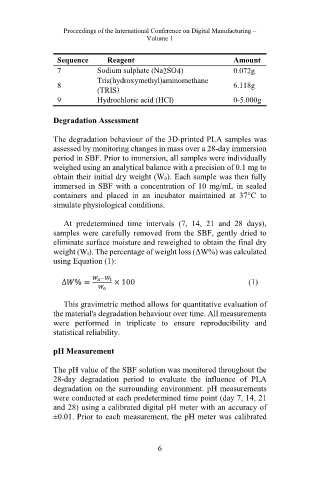
               weight (Wt). The percentage of weight loss (ΔW%) was calculated
               using Equation (1):

                                    −
                  ∆    %=       × 100                               (1)


                  This gravimetric method allows for quantitative evaluation of
               the material's degradation behaviour over time. All measurements
               were  performed  in  triplicate  to  ensure  reproducibility  and
               statistical reliability.

               pH Measurement

               The pH value of the SBF solution was monitored throughout the
               28-day degradation period to evaluate the influence of  PLA
               degradation on the surrounding environment. pH measurements
               were conducted at each predetermined time point (day 7, 14, 21
               and 28) using a calibrated digital pH meter with an accuracy of
               ±0.01. Prior to each measurement, the pH meter was calibrated


                                              6

