


Page 54 - eBook_Proceedings of the International Conference on Digital Manufacturing V1
P. 54
Proceedings of the International Conference on Digital Manufacturing –
                                         Volume 1

               MATERIALS AND METHODS

               An experimental study was conducted to evaluate the influence of
               ambient  temperature on  the quality of 3D  printed components
               under varying enclosure conditions.  The primary focus was to
               analyse the effects of utilising PMMA and blockboard as the core-
               side  walls of  a custom-built enclosure.  For benchmarking
               purposes, a comparative experiment was simultaneously executed
               under open-air, non-enclosed conditions. Acrylonitrile Butadiene
               Styrene (ABS) filament, with a diameter of 1.75 mm, was selected
               for the printing process due to its favourable thermal properties
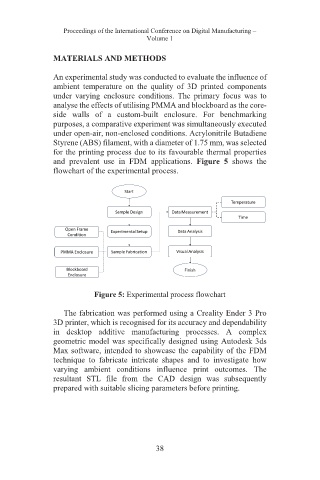
               and  prevalent use in FDM applications.  Figure  5  shows the
               flowchart of the experimental process.


                          Figure 5: Experimental process flowchart

                  The fabrication was performed using a Creality Ender 3 Pro
               3D printer, which is recognised for its accuracy and dependability
               in desktop additive manufacturing processes. A complex
               geometric model was specifically designed using Autodesk 3ds
               Max software, intended to showcase the capability of the FDM
               technique to fabricate intricate shapes and to investigate how
               varying ambient  conditions influence print  outcomes. The
               resultant  STL file  from  the CAD design was subsequently
               prepared with suitable slicing parameters before printing.


                                              38

