


Page 137 - eBook_Proceedings of the International Conference on Digital Manufacturing V2
P. 137
Fabrication and Characterization of a Low-Cost Piezoelectric using Rochelle
                         Salt for Energy Harvesting and Sensor Applications

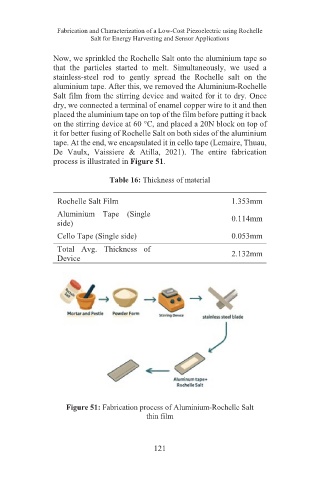
               Now, we sprinkled the Rochelle Salt onto the aluminium tape so
               that the particles started to  melt. Simultaneously,  we used  a
               stainless-steel rod  to gently spread  the Rochelle salt on the
               aluminium tape. After this, we removed the Aluminium-Rochelle
               Salt film from the stirring device and waited for it to dry. Once
               dry, we connected a terminal of enamel copper wire to it and then
               placed the aluminium tape on top of the film before putting it back
               on the stirring device at 60 °C, and placed a 20N block on top of
               it for better fusing of Rochelle Salt on both sides of the aluminium
               tape. At the end, we encapsulated it in cello tape (Lemaire, Thuau,
               De Vaulx,  Vaissiere & Atilla, 2021).  The entire fabrication
               process is illustrated in Figure 51.

                               Table 16: Thickness of material

                Rochelle Salt Film                              1.353mm
                Aluminium  Tape (Single                         0.114mm
                side)
                Cello Tape (Single side)                        0.053mm
                Total Avg. Thickness of
                Device                                          2.132mm


                   Figure 51: Fabrication process of Aluminium-Rochelle Salt
                                         thin film


                                              121

