


Page 141 - eBook_Proceedings of the International Conference on Digital Manufacturing V2
P. 141
Fabrication and Characterization of a Low-Cost Piezoelectric using Rochelle
                         Salt for Energy Harvesting and Sensor Applications

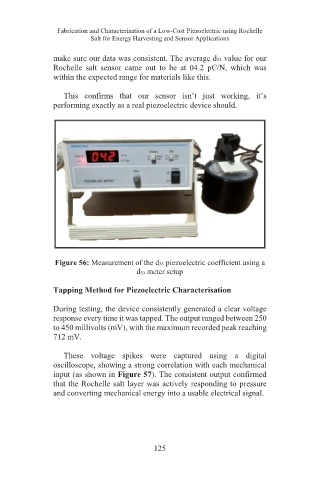
               make sure our data was consistent. The average d₃₃ value for our
               Rochelle salt sensor came out to  be at  04.2 pC/N, which  was
               within the expected range for materials like this.

                  This confirms  that our  sensor isn’t just  working,  it’s
               performing exactly as a real piezoelectric device should.


                Figure 56: Measurement of the d₃₃ piezoelectric coefficient using a
                                      d₃₃ meter setup

               Tapping Method for Piezoelectric Characterisation

               During testing, the device consistently generated a clear voltage
               response every time it was tapped. The output ranged between 250
               to 450 millivolts (mV), with the maximum recorded peak reaching
               712 mV.

                  These voltage spikes were captured using a digital
               oscilloscope, showing a strong correlation with each mechanical
               input (as shown in Figure 57). The consistent output confirmed
               that the Rochelle salt layer was actively responding to pressure
               and converting mechanical energy into a usable electrical signal.


                                              125

