


Page 142 - eBook_Proceedings of the International Conference on Digital Manufacturing V2
P. 142
Proceedings of the International Conference on Digital Manufacturing –
                                         Volume 2


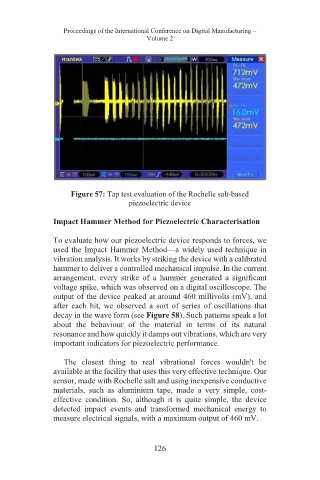
                    Figure 57: Tap test evaluation of the Rochelle salt-based
                                    piezoelectric device

               Impact Hammer Method for Piezoelectric Characterisation

               To evaluate how our piezoelectric device responds to forces, we
               used the Impact Hammer Method—a widely used technique in
               vibration analysis. It works by striking the device with a calibrated
               hammer to deliver a controlled mechanical impulse. In the current
               arrangement, every strike of a hammer generated a  significant
               voltage spike, which was observed on a digital oscilloscope. The
               output of the device peaked at around 460 millivolts (mV), and
               after each hit, we observed a sort of series of oscillations that
               decay in the wave form (see Figure 58). Such patterns speak a lot
               about the  behaviour  of the material in terms of  its natural
               resonance and how quickly it damps out vibrations, which are very
               important indicators for piezoelectric performance.

                  The closest thing  to  real vibrational forces wouldn't be
               available at the facility that uses this very effective technique. Our
               sensor, made with Rochelle salt and using inexpensive conductive
               materials,  such as  aluminium  tape,  made  a  very  simple,  cost-
               effective condition. So,  although it is  quite simple, the  device
               detected  impact  events  and  transformed mechanical energy to
               measure electrical signals, with a maximum output of 460 mV.


                                              126

