


Page 88 - eBook_Proceedings of the International Conference on Digital Manufacturing V2
P. 88
Proceedings of the International Conference on Digital Manufacturing –
                                         Volume 2

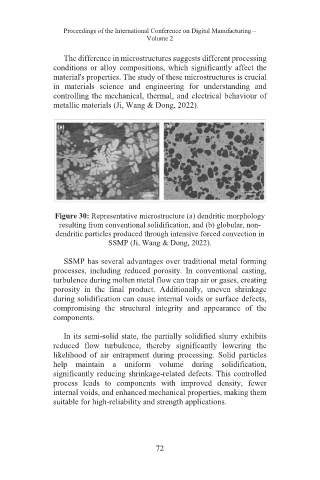
                  The difference in microstructures suggests different processing
               conditions or alloy compositions, which significantly affect the
               material's properties. The study of these microstructures is crucial
               in materials  science and  engineering for understanding and
               controlling the mechanical, thermal, and electrical behaviour of
               metallic materials (Ji, Wang & Dong, 2022).


                Figure 30: Representative microstructure (a) dendritic morphology
                 resulting from conventional solidification, and (b) globular, non-
                dendritic particles produced through intensive forced convection in
                              SSMP (Ji, Wang & Dong, 2022).

                  SSMP has several advantages over traditional metal forming
               processes, including reduced porosity. In  conventional casting,
               turbulence during molten metal flow can trap air or gases, creating
               porosity in the final product. Additionally, uneven shrinkage
               during solidification can cause internal voids or surface defects,
               compromising the structural integrity  and appearance  of the
               components.

                  In its semi-solid state, the partially solidified slurry exhibits
               reduced flow turbulence, thereby significantly lowering the
               likelihood of air  entrapment during processing. Solid particles
               help maintain  a uniform  volume during solidification,
               significantly reducing shrinkage-related defects. This controlled
               process  leads  to components with improved density, fewer
               internal voids, and enhanced mechanical properties, making them
               suitable for high-reliability and strength applications.


                                              72

