


Page 91 - eBook_Proceedings of the International Conference on Digital Manufacturing V2
P. 91
Fabrication and Characterization of a Low-Cost Piezoelectric using Rochelle
                         Salt for Energy Harvesting and Sensor Applications

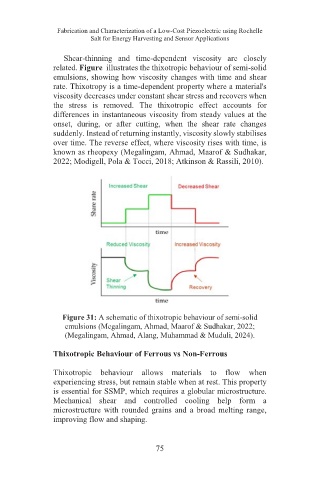
                  Shear-thinning and time-dependent viscosity are closely
               related. Figure  illustrates the thixotropic behaviour of semi-solid
               emulsions, showing how viscosity changes with time and shear
               rate. Thixotropy is a time-dependent property where a material's
               viscosity decreases under constant shear stress and recovers when
               the stress is  removed.  The  thixotropic effect accounts for
               differences in instantaneous viscosity from steady values at the
               onset, during, or after  cutting,  when the shear  rate changes
               suddenly. Instead of returning instantly, viscosity slowly stabilises
               over time. The reverse effect, where viscosity rises with time, is
               known as rheopexy (Megalingam, Ahmad, Maarof & Sudhakar,
               2022; Modigell, Pola & Tocci, 2018; Atkinson & Rassili, 2010).


                  Figure 31: A schematic of thixotropic behaviour of semi-solid
                   emulsions (Megalingam, Ahmad, Maarof & Sudhakar, 2022;
                   (Megalingam, Ahmad, Alang, Muhammad & Muduli, 2024).

               Thixotropic Behaviour of Ferrous vs Non-Ferrous

               Thixotropic behaviour  allows materials to flow when
               experiencing stress, but remain stable when at rest. This property
               is essential for SSMP, which requires a globular microstructure.
               Mechanical  shear and controlled  cooling help form a
               microstructure with rounded grains and a broad melting range,
               improving flow and shaping.


                                              75

