


Page 92 - eBook_Proceedings of the International Conference on Digital Manufacturing V2
P. 92
Proceedings of the International Conference on Digital Manufacturing –
                                         Volume 2

                  This structure gives the slurry thixotropic behaviour, meaning
               its flow changes with shear and time (Ji, Wang & Dong, 2022;
               Mohammed, Omar, Salleh, Alhawari & Kapranos, 2013;
               Megalingam, Ahmad, Alang, Muhammad & Muduli, 2024; Fei,
               Xu, Yao & Zhou, 2022).  The  formation  of  a  globular
               microstructure is essential  for  achieving  thixotropic behaviour,
               which can be controlled by adjusting the pouring temperature and
               holding time  (Tajudin, Ahmad, Alias, Razak & Alang, 2023;
               Ahmad, Naher & Brabazon, 2014; Li, Wang, Li, Liu & Zhao,
               2023; Hirt et al., 2006).

                  In SSMP, ferrous metals, like steel, and non-ferrous metals,
               like aluminium and magnesium,  show  different thixotropic
               behaviours. Ferrous metals initially become more fluid  under
               shear  stress  (shear  thinning), but  can  thicken  again  over time
               (shear  thickening).  Temperature,  initial  structure,  and  alloying
               elements  all  affect  this  behaviour  (Mohammed, Omar,  Salleh,
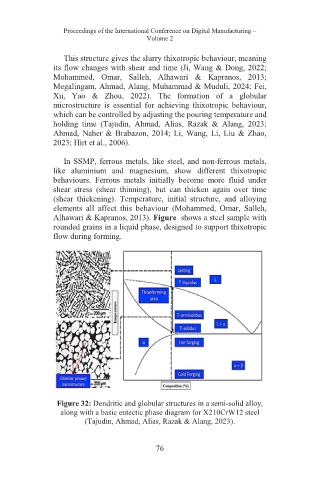
               Alhawari & Kapranos, 2013). Figure  shows a steel sample with
               rounded grains in a liquid phase, designed to support thixotropic
               flow during forming.


                Figure 32: Dendritic and globular structures in a semi-solid alloy,
                 along with a basic eutectic phase diagram for X210CrW12 steel
                        (Tajudin, Ahmad, Alias, Razak & Alang, 2023).


                                              76

