


Page 73 - eBook_Proceedings of the International Conference on Digital Manufacturing V1
P. 73
Leveraging Machine Learning to Enhance Supply Chain Agility and Strategic
                                    Operational Excellence

               offered a broad view of sales, inventory, and logistics, while the
               industry dataset provided granular,  real-time transactional
               records. Significant preprocessing was required to address data
               sparsity,  missing values, and outliers, following best practices
               recommended by Chen et al. (2021) for preparing industrial
               datasets.

                  Model selection was driven by algorithmic robustness  and
               predictive capability. Random Forest and Extreme Gradient
               Boosting (XGBoost) were chosen,  due to  their superior
               performance in complex, high-dimensional data environments, as
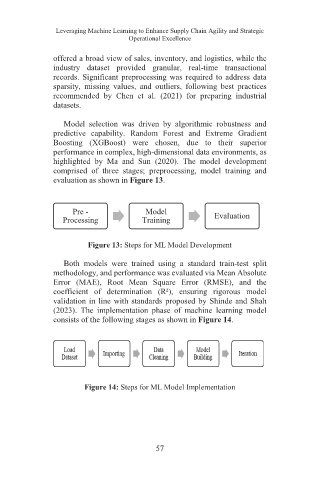
               highlighted by Ma and Sun (2020).  The model development
               comprised of three stages; preprocessing, model training and
               evaluation as shown in Figure 13.


                     Pre -              Model              Evaluation
                  Processing           Training


                         Figure 13: Steps for ML Model Development

                  Both models were  trained using a standard train-test split
               methodology, and performance was evaluated via Mean Absolute
               Error (MAE), Root Mean Square Error (RMSE), and the
               coefficient of determination  (R²), ensuring  rigorous  model
               validation in line with standards proposed by Shinde and Shah
               (2023). The implementation phase of machine learning  model
               consists of the following stages as shown in Figure 14.


                        Figure 14: Steps for ML Model Implementation


                                              57

