


Page 86 - eBook_Proceedings of the International Conference on Digital Manufacturing V1
P. 86
Proceedings of the International Conference on Digital Manufacturing –
                                         Volume 1

               RESULTS AND DISCUSSION

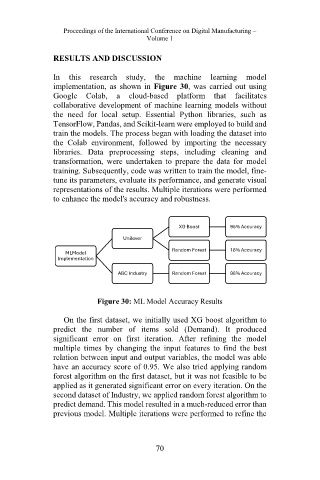
               In this research study, the machine  learning  model
               implementation, as shown in Figure 30, was carried out  using
               Google Colab, a cloud-based platform that facilitates
               collaborative development of machine learning  models without
               the need  for local  setup.  Essential  Python  libraries,  such  as
               TensorFlow, Pandas, and Scikit-learn were employed to build and
               train the models. The process began with loading the dataset into
               the Colab environment, followed by importing the necessary
               libraries. Data preprocessing steps,  including cleaning and
               transformation, were undertaken to prepare  the data for model
               training. Subsequently, code was written to train the model, fine-
               tune its parameters, evaluate its performance, and generate visual
               representations of the results. Multiple iterations were performed
               to enhance the model's accuracy and robustness.


                                                 XG Boost      95% Accuracy
                                  Unilever
                                                Random Forest  18% Accuracy
                   MLModel
                 Implementation
                                 ABC Industry   Random Forest  98% Accuracy


                           Figure 30: ML Model Accuracy Results

                  On the first dataset, we initially used XG boost algorithm to
               predict the number of  items sold  (Demand). It produced
               significant error on first iteration. After refining the model
               multiple times by changing the input features to find the  best
               relation between input and output variables, the model was able
               have an accuracy score of 0.95. We also tried applying random
               forest algorithm on the first dataset, but it was not feasible to be
               applied as it generated significant error on every iteration. On the
               second dataset of Industry, we applied random forest algorithm to
               predict demand. This model resulted in a much-reduced error than
               previous model. Multiple iterations were performed to refine the


                                              70

