


Page 143 - eBook_Proceedings of the International Conference on Digital Manufacturing V2
P. 143
Fabrication and Characterization of a Low-Cost Piezoelectric using Rochelle
                         Salt for Energy Harvesting and Sensor Applications


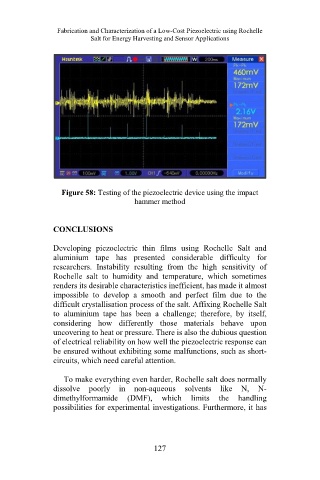
                  Figure 58: Testing of the piezoelectric device using the impact
                                     hammer method


               CONCLUSIONS

               Developing piezoelectric thin films using Rochelle  Salt and
               aluminium  tape has presented  considerable  difficulty for
               researchers. Instability resulting from the high sensitivity of
               Rochelle  salt  to humidity and temperature, which  sometimes
               renders its desirable characteristics inefficient, has made it almost
               impossible to  develop a  smooth and perfect film due  to  the
               difficult crystallisation process of the salt. Affixing Rochelle Salt
               to  aluminium  tape has been a challenge; therefore, by itself,
               considering how differently those materials behave upon
               uncovering to heat or pressure. There is also the dubious question
               of electrical reliability on how well the piezoelectric response can
               be ensured without exhibiting some malfunctions, such as short-
               circuits, which need careful attention.

                  To make everything even harder, Rochelle salt does normally
               dissolve poorly  in non-aqueous solvents like N, N-
               dimethylformamide (DMF), which  limits  the handling
               possibilities for experimental investigations. Furthermore, it has


                                              127

