


Page 23 - eBook_Proceedings of the International Conference on Digital Manufacturing V2
P. 23
Collaborative Study on Weight Optimisation of Lubricant Bottles under
                  Stacking Condition using Finite Element Analysis and Machine Learning

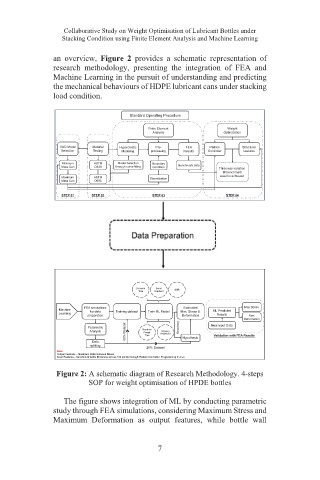
               an overview,  Figure 2  provides a schematic  representation of
               research methodology, presenting the  integration of FEA and
               Machine Learning in the pursuit of understanding and predicting
               the mechanical behaviours of HDPE lubricant cans under stacking
               load condition.

                                    Standard Operating Procedure
                                         Finite Element       Weight
                                          Analysis           Optimization
                 CAD Model  Material  Hyperelastic  Pre-  FEA  Parison  Structural
                  Selection  Testing  Modeling  processing  Results  Controller  features
                  Minimum  ASTM  Model Selection  Boundary
                  Mass Can  D638  through curve fitting  Condition  Benchmark data  Thickness variation
                                                             till benchmark
                  Maximum  ASTM          Discretization     result is achieved
                  Mass Can  D695
                  STEP 01  STEP 02        STEP 03             STEP 04


                                      Decision  Boost  SVR
                                      Tree  Gradient

                        FEA simulations            Estimated       Max Stress
                 Machine                                  ML Predicted
                         for data
                 Learning  preparation  Training dataset  Train ML Model  Max. Stress &  Results  Max
                                                  Deformation
                                                                   Deformation
                         Parametric              Accuracy  New Input Data
                         Analysis  80% Dataset  Random  Regressor  Validation with FEA Results
                                             Bagging
                                        Forest
                                        Tree
                          Data                    Hypothesis
                         splitting
                                         20% Dataset
                Note:
                Output Features – Maximum Deformation & Stress
                Input Features – Variation of bottle thickness across 100 points through Parison Controller Programming (t1-t100)

                Figure 2: A schematic diagram of Research Methodology. 4-steps
                         SOP for weight optimisation of HPDE bottles

                  The figure shows integration of ML by conducting parametric
               study through FEA simulations, considering Maximum Stress and
               Maximum Deformation as output  features, while  bottle wall
                                              7

