


Page 25 - eBook_Proceedings of the International Conference on Digital Manufacturing V2
P. 25
Collaborative Study on Weight Optimisation of Lubricant Bottles under
                  Stacking Condition using Finite Element Analysis and Machine Learning

               the experimental execution at room temperature at an extension
               rate of 2 mm/min and 50 mm/min for compression and tensile test,
               respectively. The test  results were  recorded as  load against
               displacement, which was  then converted into an engineering
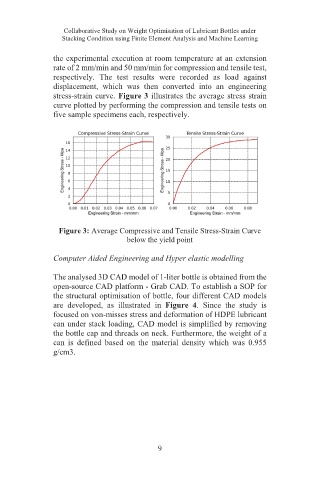
               stress-strain curve. Figure 3 illustrates the average stress strain
               curve plotted by performing the compression and tensile tests on
               five sample specimens each, respectively.


                 Figure 3: Average Compressive and Tensile Stress-Strain Curve
                                   below the yield point

               Computer Aided Engineering and Hyper elastic modelling

               The analysed 3D CAD model of 1-liter bottle is obtained from the
               open-source CAD platform - Grab CAD. To establish a SOP for
               the structural optimisation of bottle, four different CAD models
               are developed,  as illustrated in  Figure 4. Since the study is
               focused on von-misses stress and deformation of HDPE lubricant
               can under stack loading, CAD model is simplified by removing
               the bottle cap and threads on neck. Furthermore, the weight of a
               can  is defined based  on  the material density which was 0.955
               g/cm3.


                                              9

