


Page 26 - eBook_Proceedings of the International Conference on Digital Manufacturing V2
P. 26
Proceedings of the International Conference on Digital Manufacturing –
                                         Volume 2


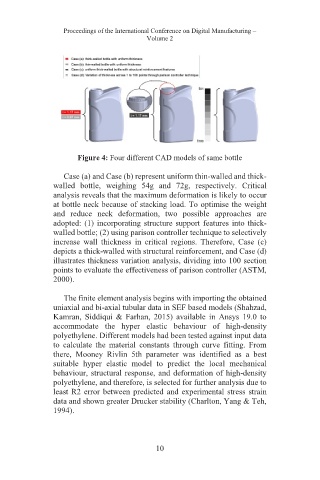
                      Figure 4: Four different CAD models of same bottle

                  Case (a) and Case (b) represent uniform thin-walled and thick-
               walled bottle, weighing 54g and 72g, respectively. Critical
               analysis reveals that the maximum deformation is likely to occur
               at bottle neck because of stacking load. To optimise the weight
               and reduce neck deformation,  two possible approaches are
               adopted: (1) incorporating structure support features into thick-
               walled bottle; (2) using parison controller technique to selectively
               increase wall  thickness  in critical regions.  Therefore, Case (c)
               depicts a thick-walled with structural reinforcement, and Case (d)
               illustrates thickness variation analysis, dividing into 100 section
               points to evaluate the effectiveness of parison controller (ASTM,
               2000).

                  The finite element analysis begins with importing the obtained
               uniaxial and bi-axial tubular data in SEF based models (Shahzad,
               Kamran, Siddiqui & Farhan, 2015)  available in Ansys 19.0 to
               accommodate  the  hyper  elastic  behaviour  of  high-density
               polyethylene. Different models had been tested against input data
               to calculate the material constants through curve fitting. From
               there,  Mooney Rivlin 5th parameter was identified as a best
               suitable hyper elastic model to predict the local  mechanical
               behaviour, structural response, and deformation of high-density
               polyethylene, and therefore, is selected for further analysis due to
               least R2 error between predicted and experimental stress strain
               data and shown greater Drucker stability (Charlton, Yang & Teh,
               1994).


                                              10

