


Page 27 - eBook_Proceedings of the International Conference on Digital Manufacturing V2
P. 27
Collaborative Study on Weight Optimisation of Lubricant Bottles under
                  Stacking Condition using Finite Element Analysis and Machine Learning

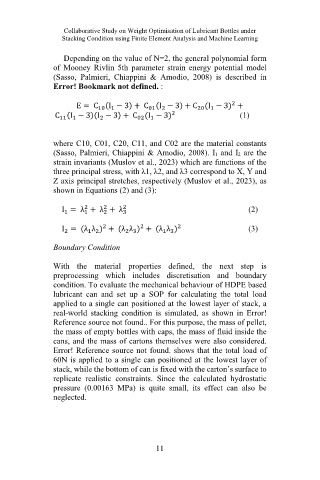
                  Depending on the value of N=2, the general polynomial form
               of Mooney Rivlin  5th  parameter strain  energy potential model
               (Sasso, Palmieri, Chiappini & Amodio, 2008)  is  described in
               Error! Bookmark not defined. :

                      E = C (I − 3) + C (I − 3) + C (I − 3) +
                                                                2
                                                      20
                                                          1
                                             2
                           10
                               1
                                         01
                C (I − 3)(I − 3) + C (I − 3)                      (1)
                                               2
                            2
                                      02
                 11
                     1
                                          1


               where C10, C01, C20, C11, and C02 are the material constants
               (Sasso, Palmieri, Chiappini & Amodio, 2008). I1 and I2 are the
               strain invariants (Muslov et al., 2023) which are functions of the
               three principal stress, with λ1, λ2, and λ3 correspond to X, Y and
               Z axis principal stretches, respectively (Muslov et al., 2023), as
               shown in Equations (2) and (3):

                  I = λ + λ + λ                                     (2)
                             2
                                  2
                        2
                        1
                                  3
                             2
                  1

                  I = (λ λ ) + (λ λ ) + (λ λ )                      (3)
                                       2
                                                 2
                             2
                                   2 3
                                             1 3
                  2
                         1 2

               Boundary Condition

               With  the material properties  defined,  the next step is
               preprocessing which  includes discretisation and boundary
               condition. To evaluate the mechanical behaviour of HDPE based
               lubricant  can  and  set up  a SOP for calculating the total  load
               applied to a single can positioned at the lowest layer of stack, a
               real-world stacking condition is simulated,  as shown in  Error!
               Reference source not found.. For this purpose, the mass of pellet,
               the mass of empty bottles with caps, the mass of fluid inside the
               cans, and the mass of cartons themselves were also considered.
               Error! Reference source not found. shows that the total load of
               60N is applied to a single can positioned at the lowest layer of
               stack, while the bottom of can is fixed with the carton’s surface to
               replicate  realistic  constraints.  Since the calculated hydrostatic
               pressure (0.00163  MPa)  is quite small, its effect  can also be
               neglected.
                                              11

