


Page 37 - eBook_Proceedings of the International Conference on Digital Manufacturing V2
P. 37
Collaborative Study on Weight Optimisation of Lubricant Bottles under
                  Stacking Condition using Finite Element Analysis and Machine Learning

               approximately 50 minutes to obtain the results from single FEA
               simulation.

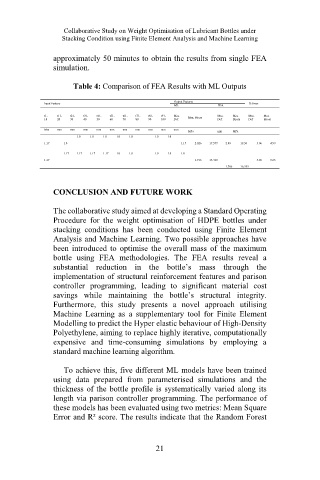
                     Table 4: Comparison of FEA Results with ML Outputs

                                                Output Features
             Input Feature                                          % Error
                                                ML          FEA
             t1-  t11-  t21-  t31-  t41-  t51-  t61-  t71-  t81-  t91-  Max.   Max.   Max.   Max.   Max.
             10   20   30   40   50   60   70   80   90   100   Def.   Max. Stress   Def.   Stress   Def   Stress
             Mm   mm   mm   mm   mm   mm   mm   mm   mm   mm   mm   MPa   mm   MPa
                      1.0   1.0   1.0   1.0   1.0   1.0   1.0
             1.17   1.0                           1.17   2.026   17.577   2.09   18.50   3.06   4.99
                  1.17   1.17   1.17   1.17   1.0   1.0   1.0   1.0   1.0
             1.17                                     1.716   15.410   4.06   5.65
                                                              1.786   16.333


               CONCLUSION AND FUTURE WORK

               The collaborative study aimed at developing a Standard Operating
               Procedure  for  the  weight  optimisation  of  HDPE bottles under
               stacking conditions has been conducted using Finite Element
               Analysis and Machine Learning. Two possible approaches have
               been introduced to  optimise  the overall mass of the maximum
               bottle using FEA methodologies.  The FEA results reveal  a
               substantial reduction in the bottle’s mass through the
               implementation of structural reinforcement features and parison
               controller programming, leading  to significant material cost
               savings while maintaining the bottle’s structural integrity.
               Furthermore, this  study presents a novel approach utilising
               Machine Learning as a supplementary tool for Finite Element
               Modelling to predict the Hyper elastic behaviour of High-Density
               Polyethylene, aiming to replace highly iterative, computationally
               expensive and time-consuming simulations by employing a
               standard machine learning algorithm.

                  To achieve this, five different ML models have been trained
               using data  prepared from parameterised simulations  and  the
               thickness of the bottle profile is systematically varied along its
               length via parison controller programming. The performance of
               these models has been evaluated using two metrics: Mean Square
               Error and R² score. The results indicate that the Random Forest


                                              21

