


Page 94 - eBook_Proceedings of the International Conference on Digital Manufacturing V2
P. 94
Proceedings of the International Conference on Digital Manufacturing –
                                         Volume 2

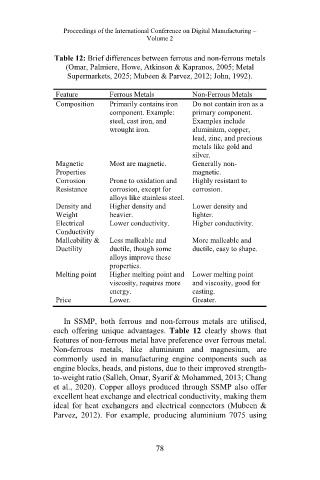
                Table 12: Brief differences between ferrous and non-ferrous metals
                   (Omar, Palmiere, Howe, Atkinson & Kapranos, 2005; Metal
                   Supermarkets, 2025; Mubeen & Parvez, 2012; John, 1992).

                Feature        Ferrous Metals        Non-Ferrous Metals
                Composition    Primarily contains iron   Do not contain iron as a
                               component. Example:   primary component.
                               steel, cast iron, and   Examples include
                               wrought iron.         aluminium, copper,
                                                     lead, zinc, and precious
                                                     metals like gold and
                                                     silver.
                Magnetic       Most are magnetic.    Generally non-
                Properties                           magnetic.
                Corrosion      Prone to oxidation and   Highly resistant to
                Resistance     corrosion, except for   corrosion.
                               alloys like stainless steel.
                Density and    Higher density and    Lower density and
                Weight         heavier.              lighter.
                Electrical             Lower conductivity.    Higher conductivity.
                Conductivity
                Malleability &     Less malleable and   More malleable and
                Ductility      ductile, though some   ductile, easy to shape.
                               alloys improve these
                               properties.
                Melting point   Higher melting point and  Lower melting point
                               viscosity, requires more   and viscosity, good for
                               energy.               casting.
                Price          Lower.                Greater.

                  In SSMP, both ferrous and non-ferrous metals are  utilised,
               each offering  unique advantages.  Table 12  clearly shows that
               features of non-ferrous metal have preference over ferrous metal.
               Non-ferrous metals,  like aluminium and magnesium,  are
               commonly used in manufacturing engine components such as
               engine blocks, heads, and pistons, due to their improved strength-
               to-weight ratio (Salleh, Omar, Syarif & Mohammed, 2013; Chang
               et al., 2020). Copper alloys produced through SSMP also offer
               excellent heat exchange and electrical conductivity, making them
               ideal for heat exchangers and electrical connectors (Mubeen &
               Parvez, 2012). For example, producing aluminium 7075 using


                                              78

