


Page 97 - eBook_Proceedings of the International Conference on Digital Manufacturing V2
P. 97
Fabrication and Characterization of a Low-Cost Piezoelectric using Rochelle
                         Salt for Energy Harvesting and Sensor Applications

                 a)                           b)


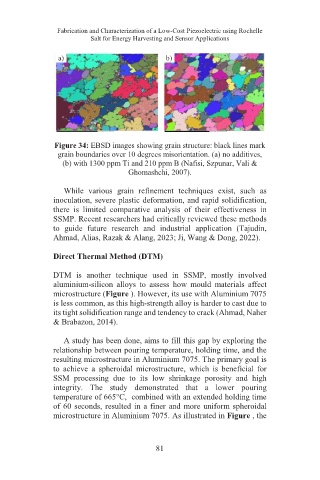
                Figure 34: EBSD images showing grain structure: black lines mark
                 grain boundaries over 10 degrees misorientation. (a) no additives,
                  (b) with 1300 ppm Ti and 210 ppm B (Nafisi, Szpunar, Vali &
                                    Ghomashchi, 2007).

                  While various grain  refinement techniques  exist,  such as
               inoculation, severe plastic deformation, and rapid solidification,
               there is  limited comparative analysis of  their effectiveness in
               SSMP. Recent researchers had critically reviewed these methods
               to guide  future research  and industrial application  (Tajudin,
               Ahmad, Alias, Razak & Alang, 2023; Ji, Wang & Dong, 2022).

               Direct Thermal Method (DTM)

               DTM is another  technique used  in SSMP, mostly  involved
               aluminium-silicon  alloys to assess how mould materials affect
               microstructure (Figure ). However, its use with Aluminium 7075
               is less common, as this high-strength alloy is harder to cast due to
               its tight solidification range and tendency to crack (Ahmad, Naher
               & Brabazon, 2014).

                  A study has been done, aims to fill this gap by exploring the
               relationship between pouring temperature, holding time, and the
               resulting microstructure in Aluminium 7075. The primary goal is
               to  achieve a spheroidal microstructure, which is  beneficial for
               SSM processing due to its low shrinkage porosity and high
               integrity.  The  study demonstrated that  a lower  pouring
               temperature of 665°C,  combined with an extended holding time
               of 60 seconds, resulted in a finer and more uniform spheroidal
               microstructure in Aluminium 7075. As illustrated in Figure , the


                                              81

