


Page 104 - eBook_Proceedings of the International Conference on Digital Manufacturing V2
P. 104
Proceedings of the International Conference on Digital Manufacturing –
                                         Volume 2


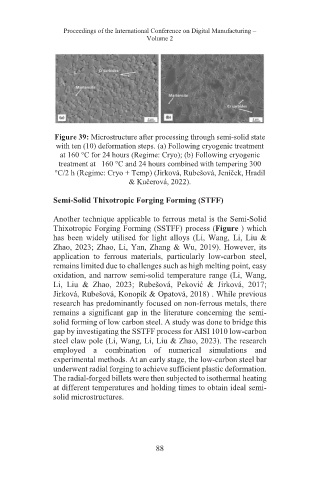
                Figure 39: Microstructure after processing through semi-solid state
                with ten (10) deformation steps. (a) Following cryogenic treatment
                 at 160 °C for 24 hours (Regime: Cryo); (b) Following cryogenic
                 treatment at   160 °C and 24 hours combined with tempering 300
                °C/2 h (Regime: Cryo + Temp) (Jirková, Rubešová, Jeníček, Hradil
                                    & Kučerová, 2022).

               Semi-Solid Thixotropic Forging Forming (STFF)

               Another technique applicable to ferrous metal is the Semi-Solid
               Thixotropic Forging Forming (SSTFF) process (Figure ) which
               has  been widely utilised for  light alloys  (Li, Wang, Li, Liu &
               Zhao, 2023; Zhao, Li, Yan, Zhang & Wu, 2019). However, its
               application to ferrous materials, particularly low-carbon steel,
               remains limited due to challenges such as high melting point, easy
               oxidation, and narrow semi-solid temperature range (Li, Wang,
               Li,  Liu  &  Zhao,  2023;  Rubešová,  Peković  &  Jirková, 2017;
               Jirková, Rubešová, Konopík & Opatová, 2018) . While previous
               research has predominantly focused on non-ferrous metals, there
               remains a significant gap in the literature concerning the semi-
               solid forming of low carbon steel. A study was done to bridge this
               gap by investigating the SSTFF process for AISI 1010 low-carbon
               steel claw pole (Li, Wang, Li, Liu & Zhao, 2023). The research
               employed  a combination of numerical simulations and
               experimental methods. At an early stage, the low-carbon steel bar
               underwent radial forging to achieve sufficient plastic deformation.
               The radial-forged billets were then subjected to isothermal heating
               at different temperatures and holding times to obtain ideal semi-
               solid microstructures.


                                              88

