


Page 99 - eBook_Proceedings of the International Conference on Digital Manufacturing V2
P. 99
Fabrication and Characterization of a Low-Cost Piezoelectric using Rochelle
                         Salt for Energy Harvesting and Sensor Applications


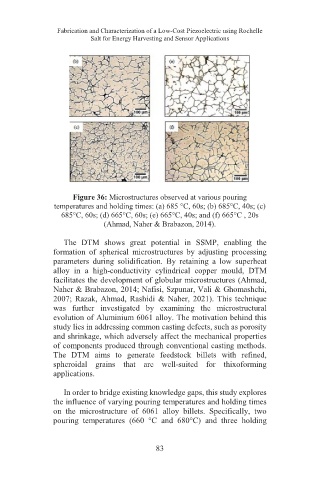
                     Figure 36: Microstructures observed at various pouring
                temperatures and holding times: (a) 685 °C, 60s; (b) 685°C, 40s; (c)
                  685°C, 60s; (d) 665°C, 60s; (e) 665°C, 40s; and (f) 665°C , 20s
                             (Ahmad, Naher & Brabazon, 2014).

                  The  DTM shows  great potential in  SSMP, enabling the
               formation of spherical microstructures by adjusting processing
               parameters during solidification. By retaining a low superheat
               alloy  in  a  high-conductivity  cylindrical  copper  mould,  DTM
               facilitates the development of globular microstructures (Ahmad,
               Naher & Brabazon, 2014; Nafisi, Szpunar, Vali & Ghomashchi,
               2007;  Razak, Ahmad, Rashidi & Naher, 2021). This  technique
               was further investigated by examining the microstructural
               evolution of Aluminium 6061 alloy. The motivation behind this
               study lies in addressing common casting defects, such as porosity
               and shrinkage, which adversely affect the mechanical properties
               of components produced through conventional casting methods.
               The DTM  aims to generate feedstock billets with refined,
               spheroidal grains that  are well-suited for thixoforming
               applications.

                  In order to bridge existing knowledge gaps, this study explores
               the influence of varying pouring temperatures and holding times
               on the microstructure of  6061 alloy billets. Specifically, two
               pouring temperatures (660 °C and 680°C) and  three holding


                                              83

