


Page 98 - eBook_Proceedings of the International Conference on Digital Manufacturing V2
P. 98
Proceedings of the International Conference on Digital Manufacturing –
                                         Volume 2

               microstructure varied  significantly with changes in pouring
               temperature and holding time. A higher cooling rate was found to
               promote the  formation of more spheroidal structures.
               Additionally, the fraction solid at the time of quenching played a
               critical role in microstructure development, and higher fraction
               solids led to more spherical morphologies.

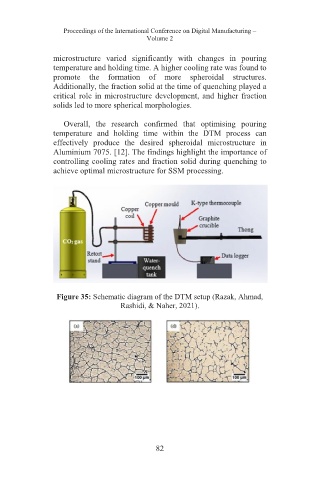
                  Overall,  the research confirmed  that  optimising  pouring
               temperature and holding time within  the DTM process can
               effectively produce the desired spheroidal microstructure in
               Aluminium 7075. [12]. The findings highlight the importance of
               controlling cooling rates and fraction solid during quenching to
               achieve optimal microstructure for SSM processing.


                Figure 35: Schematic diagram of the DTM setup (Razak, Ahmad,
                                  Rashidi, & Naher, 2021).


                                              82

